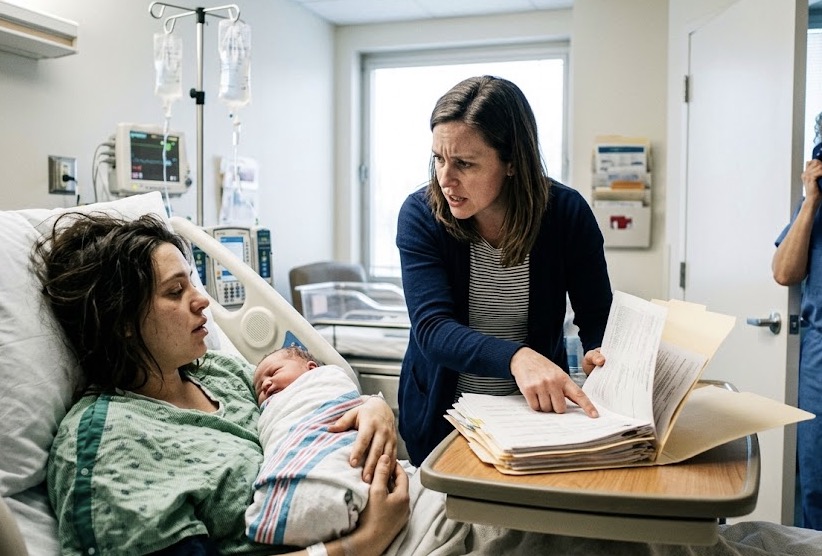
The photograph from that morning looks peaceful: my daughter tucked beside my face, both of us exhausted, me smiling like the worst was finally behind us—but about twenty minutes after that picture was taken, hospital security was called to my room because of my own sister.
I had barely slept.
My daughter, Nora, had been born just before sunrise after a labor that lasted so long I stopped caring what time it was.
By morning, my hair was stuck to the side of my face, my hospital gown was twisted under me, and I had an IV taped across my right hand.
I felt awful.
I also felt happier than I knew how to explain.
Nora was lying beside me wrapped in one of those white hospital blankets with the pink and blue stripes. She wore a little cream-colored knit cap that kept sliding almost over her eyebrows.
Every few minutes I would touch her cheek just to make sure she was real.
I was twenty-eight years old, single, scared about money, living in a small rental outside Olympia, Washington, and absolutely unprepared for half the things that were coming.
But I knew one thing.
She was mine.
And I wanted her.
That sounds like something a mother should never have to say out loud.
Unfortunately, by lunchtime that day, I would have to say it over and over.
My older sister, Lenora, arrived a little after eleven carrying an enormous canvas tote bag.
She was seven years older than me and had always been the organized one in our family.
When we were kids, I lost homework inside my own backpack.
Lenora labeled the shelves in her bedroom.
As adults, not much had changed.
She remembered birthdays.
She sent thank-you cards.
She owned a label maker.
She had also been the person who helped me most during my pregnancy.
When Nora’s father disappeared during my fourth month—not literally disappeared, just decided fatherhood “wasn’t something he could handle”—Lenora was there.
When my hours at work were cut, Lenora bought groceries.
When my car battery died outside my OB’s office, she drove forty minutes to get me.
When I started having blood-pressure problems near the end of the pregnancy, she came to appointments and wrote down everything the doctor said because I was too nervous to remember it.
That was why seeing her walk into my hospital room made me smile.
“You look terrible,” she said.
I laughed.
“Nice to see you too.”
Then she saw Nora.
Her whole expression changed.
She put the tote bag down.
“Oh,” she whispered.
That was all.
Just oh.
She came closer and stood beside the bed staring at my daughter.
Lenora and her husband, Wes, had tried to have children for nearly nine years.
There had been treatments.
Procedures.
Two miscarriages that I knew about.
Another pregnancy they rarely discussed because Lenora lost it late enough that they had already painted the nursery.
Eventually they stopped trying.
Or at least I thought they had.
So when she looked at Nora with tears in her eyes, I understood.
At least, I thought I understood.
“Want to hold her?” I asked.
Lenora looked at me quickly.
“You mean it?”
“Of course.”
I lifted Nora carefully.
My sister sat in the chair beside the bed and took her.
For a few seconds, Lenora looked exactly like the sister I knew.
She smiled.
She touched Nora’s nose.
She whispered, “Hi, sweetheart.”
Then she said something I didn’t quite catch.
“What?”
“Nothing.”
“What did you say?”
Lenora glanced at me.
“I said we finally got you here.”
Something about the sentence bothered me.
Not enough to scare me.
Just enough that I remembered it later.
A nurse named Carmen came in carrying paperwork and a plastic cup of water.
She checked my IV, asked about pain, then looked at Nora.
“Look who’s awake.”
Nora had opened one eye.
Lenora smiled.
“She does that.”
The nurse gave her a slightly confused look.
Then she looked at me.
“We also need to finish a couple discharge details whenever you’re feeling up to it.”
“Sure.”
She put the paperwork on the table.
Lenora immediately asked, “Will that be today or tomorrow?”
“Depends on Mom and baby.”
“I think tomorrow would be better.”
Carmen looked at me.
I laughed awkwardly.
“My sister likes planning.”
“I can tell.”
Lenora didn’t laugh.
She adjusted Nora’s blanket instead.
A minute later, Carmen asked me to confirm the address where Nora would be going after discharge.
I gave her my address.
Lenora’s hands stopped moving.
“You’re using that address?”
I looked at her.
“Yes.”
There was a strange silence.
Carmen glanced between us.
Lenora smiled quickly.
“Sorry. I thought you might use ours because somebody will be home all day.”
“No. She’s coming home with me.”
My sister stared at me.
Not angrily.
That almost would have been easier.
She looked confused.
Like I had just changed the ending of a movie we’d both already seen.
“Kendra.”
That was the first time she used my name since walking into the room.
“What?”
“Can we talk about this later?”
“There isn’t really anything to talk about.”
Carmen quietly collected one of the forms and said she would come back.
The moment the door closed, Lenora lowered her voice.
“I don’t think we need to do this right now.”
“Do what?”
“You’re exhausted.”
“So?”
“You just gave birth.”
“I know.”
“Your hormones are all over the place.”
I remember staring at her because I couldn’t understand why we were arguing.
“Lenora, what are you talking about?”
She looked down at Nora.
My baby was sleeping again.
“You said you wanted her to have stability.”
“I do.”
“You said you didn’t know how you’d afford daycare.”
“I don’t.”
“You said your apartment is barely big enough.”
“Okay…”
“And you said you couldn’t do this alone.”
“I was scared.”
“You weren’t just scared, Kendra.”
Her voice had become sharper.
“You asked me for help.”
“I ask you for help all the time.”
“No.”
She shook her head.
“Not like this.”
I sat up a little farther despite the pain in my stomach.
“What exactly do you think I asked you?”
Lenora didn’t answer immediately.
Instead, she looked toward the door.
Then she stood with Nora in her arms.
That bothered me.
“Give her to me.”
Lenora looked shocked.
“Why?”
“Because you’re acting weird. Give me my baby.”
“Kendra.”
“Give her to me.”
She hesitated.
Only for a second.
But I saw it.
I reached toward Nora.
My sister stepped backward.
That was when I raised my voice.
“Lenora.”
The door opened almost immediately.
Carmen came back inside.
“Everything okay?”
“Yes,” Lenora said.
“No,” I said at exactly the same time.
Carmen’s expression changed.
She looked at my sister.
“I’m going to ask you to put the baby back in the bassinet, please.”
Lenora stared at her.
“She’s fine with me.”
“I’m sure she is. But Mom is asking for her.”
My sister’s face flushed.
“You don’t understand.”
Carmen remained calm.
“Then put the baby down and explain it to me.”
For another few seconds, Lenora didn’t move.
Finally, she placed Nora in the bassinet.
I reached over immediately and pulled the bassinet closer to my bed.
Carmen asked Lenora to step toward the other side of the room.
My sister looked humiliated.
“This is ridiculous.”
I said, “Then tell me what is happening.”
Lenora grabbed the large tote bag she had brought with her.
She started digging through it.
There were diapers inside.
Baby clothes.
A bottle.
A small stuffed rabbit.
I remember looking at those things and thinking it was odd that she had brought half a diaper bag to a hospital where everything for a newborn was already provided.
Then she pulled out a folder.
It was thick.
Not a greeting card.
Not insurance forms.
A folder.
She opened it and removed several pages.
“I didn’t want to do this in front of a nurse,” she said.
“Do what?”
She walked toward me and placed the papers on the hospital tray.
I saw my name.
I saw Lenora’s name.
Then I saw Nora’s name typed into a blank space that looked far too official for something she had printed at home.
My daughter had been alive less than a day.
Her name was already on a document I had never seen.
I looked up.
“What is this?”
Lenora’s eyes filled with tears.
And then she said the sentence that brought hospital security to my door.
“You can’t suddenly change your mind, Kendra. You already signed her over to us.”
For a moment, nobody spoke.
I picked up the first page.
My hands were shaking badly enough that the paper made a soft rattling sound against the plastic tray.
There was a signature at the bottom.
It looked like mine.
Sort of.
The K was too narrow.
The last name leaned upward.
But if you weren’t paying attention, you could believe it.
Carmen stepped closer.
“Ma’am, are you saying you did not sign this?”
“No.”
Lenora made this frustrated sound.
“That’s not true.”
I looked at her.
“When did I sign it?”
“At your apartment.”
“When?”
“In August.”
“What day?”
She opened her mouth.
Nothing came out.
I remembered August very well.
I had been twenty-nine weeks pregnant, working inconsistent shifts at a dental supply company and crying at stupid things like grocery receipts.
One night, Lenora came over after I called her because I had received a bill I couldn’t pay.
I told her I was terrified.
I told her maybe Nora deserved people who had money and a house and two parents.
I also said something I would regret for months.
“Sometimes I wonder if she’d be better off with you.”
I remembered Lenora hugging me.
I remembered her saying, “Whatever happens, we’ll figure it out.”
But wondering whether somebody else could give my child more was not the same as agreeing to give my child away.
Not to me.
Apparently, it had been something very different to Lenora.
“Is this about that night?” I asked.
She stared at me.
“You asked us.”
“No. I didn’t.”
“You did.”
“I said maybe.”
“You said she’d be better with us.”
“I was crying on my couch because I had ninety-four dollars until payday!”
The nurse quietly picked up the phone beside my bed.
Lenora pointed at the paperwork.
“You signed forms.”
“What forms?”
“The forms I brought later.”
Then I remembered those too.
About three weeks after that conversation, I had been sent to the hospital because my blood pressure was dangerously high.
Lenora stayed with me most of the night.
She brought paperwork she said would allow her to speak with doctors or help make decisions if I became too sick to handle things myself.
I signed two pages.
Maybe three.
I didn’t read every sentence.
That is one of the stupidest things I have ever done.
But none of the documents I remembered mentioned adoption.
I told Carmen that.
She nodded.
“Security is on the way.”
Lenora went pale.
“You called security?”
“Yes.”
“Why?”
“Because the baby’s mother asked for her child back and you initially refused.”
“She isn’t thinking clearly.”
“That’s enough.”
Carmen’s voice wasn’t loud.
It didn’t need to be.
Lenora started crying.
Not dramatic crying.
Quiet tears.
That somehow made it worse.
Then my phone began ringing.
It was Wes.
I stared at his name.
Lenora looked at the screen too.
“Don’t.”
That single word told me I absolutely needed to answer.
“Hi?”
Wes sounded breathless.
“Kendra, where is Lenora?”
I looked at my sister.
“She’s here.”
There was a pause.
Then he said, “With the baby?”
“Yes.”
Another pause.
Longer this time.
“Do not let her leave.”
I felt something twist in my stomach that had nothing to do with giving birth.
“What is going on?”
“I’ll explain when I get there.”
“You need to explain now.”
He exhaled.
Then he said something I still remember word for word.
“Kendra, everybody we know thinks we’re bringing that baby home tomorrow.”
I stared at my sister.
“What?”
Lenora covered her face.
Wes continued.
“My parents know. Her friends know. People from church know. There was a shower two weeks ago.”
I honestly thought I’d misunderstood him.
“A baby shower?”
“Yes.”
“For my baby?”
“I thought you knew.”
The room suddenly felt too small.
Lenora had told me she was going to a retirement party that Saturday.
She had even sent me a photograph of herself dressed up.
Apparently, she’d been standing inside a room filled with gifts for my unborn daughter.
“Why would you think I knew?” I asked.
“Because she told me you didn’t want people bothering you about it.”
I looked at my sister.
She was crying harder now.
Wes said, “She told me you agreed months ago.”
I couldn’t answer.
Because suddenly all the strange things from the pregnancy started rearranging themselves in my head.
The expensive stroller Lenora insisted on buying.
The questions about formula.
The way she kept asking whether I liked the name Nora or whether I was “still deciding.”
The appointment she wanted to attend with me.
Her asking for a copy of my insurance card.
The car seat she said she was keeping at her house “just in case.”
None of those things had seemed dangerous individually.
Together, they looked completely different.
Security arrived.
Two officers entered.
A hospital administrator came with them.
Lenora tried to explain.
Then I tried to explain.
Then everybody spoke at once.
Eventually, one officer asked Lenora to step into the hallway.
She refused.
Not violently.
She just kept saying, “No, you’re making this look insane.”
Then she turned toward me.
“Kendra, tell them.”
“Tell them what?”
“That you asked me.”
“I didn’t.”
“You did.”
“I was scared!”
“So was I!”
Her voice cracked.
And suddenly all that controlled, organized Lenora disappeared.
“You have no idea what it’s like watching everybody else get the one thing you can’t have.”
The room became silent.
She pointed toward Nora.
“I spent nine years watching people complain about being pregnant. Complain about diapers. Complain their kids woke them up. I would have given anything for that.”
I said quietly, “I know.”
“No, you don’t.”
“You’re right. I don’t.”
Then I looked at the paperwork.
“But that doesn’t make her yours.”
Lenora’s expression changed.
That sentence hit her.
She sat down.
Nobody said anything for a few seconds.
Then she whispered, “I already built her room.”
I almost felt sorry for her.
Almost.
But Nora moved inside the bassinet and made one of those tiny newborn noises.
And whatever sympathy I felt was immediately followed by anger.
“You built a room for my child without telling me.”
Lenora looked at the floor.
“Yes.”
“And you had a shower.”
She nodded.
“And you told people I gave her to you.”
Another nod.
“Why?”
She wiped her face.
“Because once I started saying it, I didn’t know how to stop.”
That sentence was probably the most truthful thing she said all day.
Wes arrived about forty minutes later.
He looked like somebody had punched him.
He didn’t go to Lenora first.
He came directly to my bed.
“I’m sorry.”
I had known Wes for twelve years.
I had never seen him cry before.
“I swear to you, Kendra, I thought you had agreed.”
I believed him.
Later, I learned Lenora had even shown him text messages from me out of context.
Messages where I said things like:
I don’t know how I’ll do this.
She’s lucky to have you.
I couldn’t survive this pregnancy without you.
Normal sentences.
But arranged beside Lenora’s version of events, they sounded like something else.
Wes told me he had repeatedly asked whether they needed an attorney.
Lenora told him everything would be handled after the birth.
The paperwork she brought to the hospital wasn’t legally valid as an adoption.
The hospital figured that out very quickly.
One of the pages appeared to be a template downloaded online.
Another had been modified from the medical authorization I’d actually signed.
The signature on the final page was not mine.
Police took copies.
I could have pushed the situation much farther legally.
For a while, I thought I would.
Maybe I should have.
But at the time, I was exhausted, sore, terrified, and holding a newborn.
I wanted my sister away from me.
That was all.
Lenora was escorted out of the maternity floor.
Before she left, she turned toward me.
I expected another argument.
Instead, she looked at Nora and whispered, “I’m sorry.”
I didn’t answer.
The following afternoon, I took my daughter home.
Not to Lenora’s house.
Not to the beautiful nursery she had apparently spent months building.
To my cramped two-bedroom rental with the noisy refrigerator and the neighbor upstairs who vacuumed at ridiculous hours.
I had a secondhand crib.
Three packs of diapers.
Frozen dinners my mother brought over.
And exactly $211 in my checking account after rent cleared.
But Nora came home with me.
The first few months were hard.
Really hard.
There were nights I sat on the kitchen floor holding her because it was the only place where the sound of the exhaust fan calmed her down.
I returned to work earlier than I wanted.
My mother watched Nora three days a week.
I found a daycare run by a woman named Mrs. Daugherty who had been caring for children in her house since before I finished middle school.
Money was constantly tight.
I bought baby clothes from consignment stores.
I learned which grocery store marked meat down on Wednesday mornings.
And there were absolutely moments when I wondered whether Lenora had been right about one thing.
Maybe Nora could have had an easier life somewhere else.
But easier isn’t the same as better.
And struggling doesn’t mean you stop being somebody’s mother.
Wes moved out of their house about a month after the hospital incident.
I didn’t ask him to.
I didn’t even know until my mother told me.
He and Lenora eventually separated.
Not because she couldn’t have children.
Not even entirely because of what happened with Nora.
According to him, it was because he realized he no longer knew when Lenora was telling him the truth.
That broke something between them.
Lenora started therapy.
For nearly ten months, I didn’t speak to her.
She sent birthday cards to me.
Christmas gifts for Nora.
I returned the first two.
I kept the third in a closet unopened for almost a month.
Eventually I opened it.
It was a wooden music box.
No letter asking to visit.
No request for forgiveness.
Just a small card.
It said:
I know loving her did not give me the right to claim her. I know helping you did not create a debt. I am sorry I made my grief your responsibility.
That was the first apology from Lenora that didn’t include the word but.
I kept the card.
I still wasn’t ready to see her.
People sometimes act like forgiveness is a door.
You open it.
Everybody walks through.
The family is fixed.
I don’t think it works that way.
For me, forgiveness looked more like removing one lock at a time.
I stopped being angry every morning.
Then I stopped checking my locks twice at night.
Then I stopped wondering whether Lenora was going to show up at Nora’s daycare.
Eventually, I agreed to meet her for coffee.
Just the two of us.
Nora stayed with my mother.
Lenora looked older.
Not physically, exactly.
Just tired in a way I hadn’t seen before.
She didn’t ask to see Nora.
That mattered.
We talked for almost two hours.
There was no big reunion.
No dramatic hug.
Mostly there were uncomfortable silences.
At one point she said, “I think I convinced myself that because I could give her more, wanting her was somehow generous.”
I asked, “Do you still believe that?”
“No.”
She stirred her coffee.
“I think I wanted to turn my pain into something good so badly that I stopped caring who I hurt.”
That answer didn’t fix everything.
But it sounded real.
Nora is almost two now.
She’s loud.
Fearless.
Obsessed with blueberries.
She hates socks and somehow manages to remove them in the car even when I think I’ve put them on properly.
The hospital photograph of us is framed in my bedroom.
Sometimes people see it and say, “You look so peaceful.”
And I laugh.
Because I know what happened twenty minutes later.
I know that while I was lying there smiling beside my newborn, my sister had a tote bag on the floor containing clothes for a baby she believed she was taking home.
I know there was a nursery waiting in another house.
A car seat installed in another car.
People expecting photographs of another woman’s new daughter.
For a long time, that made the picture feel ruined.
Now it doesn’t.
Now when I look at it, I notice something else.
My hand is resting beside Nora.
Even exhausted, even medicated, even completely unaware of what was about to happen, I had moved my hand toward her.
Almost like I was protecting her without knowing I needed to.
Lenora has seen Nora twice since then.
Both times were with me there.
I don’t know what their relationship will become.
I’m not promising anyone anything anymore.
Not Lenora.
Not my parents.
Not relatives who think “family should move on.”
Maybe someday my sister will become someone Nora knows and trusts.
Maybe she won’t.
That decision will be made slowly.
Not because somebody bought groceries.
Not because somebody decorated a nursery.
Not because somebody helped me when I was scared.
And definitely not because of a piece of paper in a hospital tote bag.
I used to feel guilty saying that.
I don’t anymore.
Because the lesson I took from that morning wasn’t that my sister was evil.
She wasn’t.
She was grieving, dishonest, desperate, and terribly wrong.
Sometimes people we love can hurt us without becoming monsters.
And sometimes understanding why they did it doesn’t mean we have to pretend it didn’t happen.
Nora was never a reward for helping me.
She wasn’t a solution to Lenora’s grief.
She wasn’t something our family could redistribute according to who had the bigger house or the better bank account.
She was my daughter.
That morning in the hospital, surrounded by paperwork, nurses, security officers and a sister I barely recognized, that was the only fact that mattered.